Showing posts with label first aid. Show all posts

Wednesday, February 15, 2017

Thumb's Up

Well, I did myself a good one just the other day. Nearly took the end of my thumb clean off. A kitchen utensil called a mandolin, used for slicing vegetables, was involved.
The culprit

Normally I'm much safer with blades, having been using them for so long. Guess I need to rip a corner off my Totin' Chip card. 

On to the first aid instruction portion of this post. Remaining calm when an accident has happened is the most important thing. Panic wastes valuable time needed for the treatment and recovery of the patient. Although, if you hurt yourself, using language that would melt a pirate's ear is an understandable response. After hopping around uttering choice exclamations, I got my bleeding thumb under the faucet to clean the injury and begin assessing the damage. I lost a few tablespoons of blood which helped carry contaminants out of the wound. My girlfriend brought over the first aid kit and I directed her in applying a bandage and dressing to the cut. 
Sharp dressed man
After any injury, a patient must also be treated for shock which is characterised by a drop in blood pressure and body temperature. I laid down under a blanket and also took a pain reliever. Aspirin, being a blood-thinner, would have been a poor choice of pain reliever but pain relieving and fever reducing ibuprofen is ideal for this type of accident. Take only as directed. 

I left the dressing on for 24 hours to ensure that bleeding was controlled, prevent infection, and begin healing the injury. After about 24 hours the dressing and bandage should be removed so the injury can be cleaned again, allowed air and blood circulation, and examined. The examination is to check for and treat infection and be sure the wound has begun healing. Cover the wound with a new bandage and clean dressing if it is likely to continue or resume bleeding. Otherwise, allow the wound air and full circulation to heal. 
The result


Wednesday, April 22, 2015

Scalded Dog

Hotels want to provide amenities like hot water for their guests.  As a consequence they'll often turn their water heaters up to their highest available temperature to guarantee at least some hot water under even the highest demand.  But sometimes actual safety is overlooked and faucets can release boiling hot water and injure guests.

Burn baby burn
Hot water can cause significant burns very quickly.  In the picture above, my foot was under the bathtub faucet for only an instant and received first and second degree burns in less than a second.  The red oval is the blister from the second degree burn which immediately ruptured and peeled off.  The blushing around it is the first degree burn caused by less direct contact with the water and energy spreading off the second degree burn.  The rest of the foot wasn't as pale as it appears in this photo; it's just poor color management in the camera and no post-production.

Even though this is a second degree burn, this is very small.  First aid training teaches the Rule of Nines to measure the area of a burn.  Human anatomy divides up readily into multiples of nine percent of the skin's surface area.  Your palm is one percent, an entire forearm and hand front and back is nine percent, the anterior torso (the front of the chest) is eighteen percent, etcetera.  First degree burns aren't counted, only second and third degree burns matter for this.  First degree burns are superficial, like a sunburn.  Second degree burns are more damaged, often characterized by blisters and damage in deep layers of skin.  Third degree burns are severely damaged, charring skin and exposing bone.  Of course, because these degrees categorize how much energy the skin was exposed to, higher degree burns will have lower degree burns around their periphery where skin was exposed to less damage.  This particular injury above is a fraction of a percent of burned area.

First aid for a burn like this is immediate immersion into cold water to take away the excess heat energy and stop the burning.  Burns can continue to develop for 72 hours after the initial injury due to the excess heat in the tissues.  Treatment continues by covering the significant burns with a sterile bandage and dressing.  Then the patient would normally be transported to a burn center.  Or be me, trained to treat serious but small non-life-threatening burns like this.  And I had stuff to do that day.

Friday, June 7, 2013

Laceration

As a Scout leader trained in Wilderness and Remote First Aid, I am well qualified to report on first aid incidents.  I've written before about my own injuries and here's another first aid article.  Fortunately, I'm not the one who got injured this time.
In stitches. Not funny. 

This is one of my scouts from Boy Scout Troop "Hardcore" 444, who sliced his hand deeply while using a knife in an unsafe manner.  The exact circumstances don't need to be reported but, needless to say, he received prompt and appropriate medical care, including a trip to the hospital for stitches.  This photo is from after the boy returned to camp that night. 
So there's this misconception that "two-deep leadership" means only two adults are needed on any activity.  This event proves that wrong.  Troop 444 operates with at least four adults for just this sort of situation.  If we didn't have enough adult leaders, everyone would have had to break camp and go to the hospital.   As it was, we were able to send the injured scout, two more scouts, and two adults to the hospital while the remainder of the troop stayed at the camp out and continued with the program.  We were able to play it by the book to take care of an emergency while continuing to deliver the Scouting program.
Proper medical care for a cut like this is direct pressure to stop the bleeding.  Use a shirt, neckerchief, or, as we had available, a large gauze pad from our well-stocked troop first aid kit.  The blood flow was doing a good job washing out the cut on its own and indicated that stitches would be needed.  If there isn't as much blood, wash the cut with clean soapy water, rinse with clean water, and bandage with gauze.  But in this case, it was gauze and more gauze then prep for travel.
Also, treat for shock by sitting the patient down and applying first aid quickly and professionally.  You can wrap the patient in a blanket and have them sip water, as well.
The injured scout was able to return to camp that night and participate in the closing campfire program.  During an after action report type activity we call "Roses, Buds, and Thorns", this scout complained about the lack of speedy response when he injured himself.  Not to be mean, but he was corrected and it was pointed out that he was treated and ready for travel in ten minutes and at the hospital within the golden hour.  Then the adult leaders discussed with the rest of the scouts about the proper treatment for this type of injury, simply grabbing cloth and applying direct pressure.  
By being prepared with training and equipment, this scout has made a full recovery and doesn't even have a scar to brag about. 

Tuesday, December 11, 2012

Buzz Off

Provided there is no allergic reaction, the first aid for a bee sting is simple. Quickly remove the stinger by scraping with the back edge of a blade or card.  After that, treat the injury as you would a puncture wound.  That is, wash with soap and clean water.  Because of the injected venom an insect sting can quickly become complicated.  In severe cases it can cause a condition known as anaphylaxis.  This life-threatening condition is characterized by a whole-body allergic reaction including hives and difficulty breathing.

Luckily, I am not that susceptible to bee venom.  But my minor allergic reaction to getting stung last summer means I am at increased risk of anaphylaxis in the future.  I was at summer camp at Camp Fiesta Island, San Diego, CA, the week of 4 July with my Boy Scout troop.  For the rest of this article, I present my point of view of an injury and its treatment.

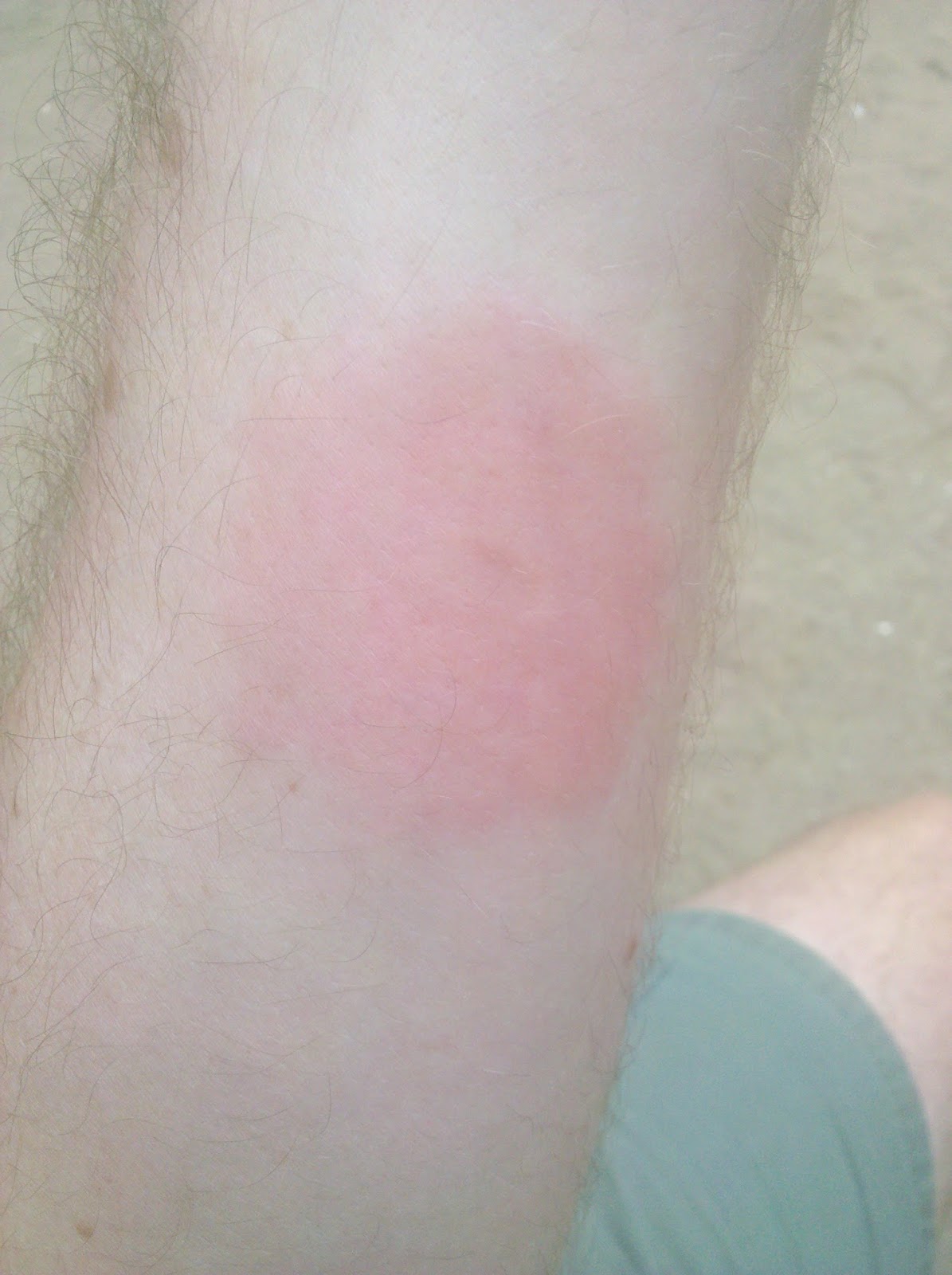
Here is a picture from immediately after the bee sting.  To give the viewer some perspective, that is my left forearm above a table.  The bee sting is the reddening spot on the right (underside) of the arm.  This bee had discovered a nice place to rest in a fold of my T-shirt when I brushed my arm against her.
Bee sting is on the side of the arm. Picture taken immediately after impact.

I knew this was a relatively minor injury for me and cleaned my arm after scraping out the stinger.  Then I watched for allergic reaction and was prepared to treat for shock.  As it happens, the bee sting did lead to an allergic reaction.  I treated the symptoms with calamine lotion to control the itching and antibiotic lotion to prevent infection. 
One day after I attacked a resting bee.

The venom spread slowly, as it does, through the muscle tissue in my arm.  It looked the worst several days after the attack.  
Bulls eye.  Three days later.

After about a week, I still had a bruise from the tissue damaged by the venom but had otherwise recovered.  It's important to note that I was not grievously injured here.  Bees leave only small puncture wounds but can cause serious allergic reactions.  This is clearly an allergic reaction but it is minor.  
Just a bruise.  

Tuesday, May 10, 2011

This (frost)bites

I did a good one on myself a while back. It was the Boy Scouts' District Camporee and I'd just woken up and, by definition, required coffee. I got out the propane stove and began setting it up. Unfortunately, I didn't realize the propane hose was pressurized and it let out a blast of propane from the fitting. Now, the day was going to warm up but mornings are still cool here in the desert. And, actually, the depressurizing jet of gas alone was cold enough to cause frostbite. So that's what it did; right across the back of my right index finger. What did I do? Grabbed it with my left hand to finish tightening down the fitting. And now I had frostbite across the back of my left index finger, too.

Warning, the following section includes graphic pictures of injury.